
I Spent Decades Trying to Fix My Sleep—Until I Learned It Wasn’t Broken
For most of my adult life, I believed I had a sleep problem.
I tried everything: supplements, sleep aids, strict routines, “perfect” sleep hygiene, tracking apps, CBT-I, and rules about getting out of bed if I wasn’t asleep in 15 minutes. Though I’ve always fallen asleep quickly when going to bed, anxiety started when I woke up in the middle of the night.
Because I almost always woke up. Around 2 or 3 a.m., my eyes would open and my mind would turn on. I would lie there thinking how will I be able to function if I can’t get back to sleep? I would usually be awake for at least an hour – sometimes up to 2.5 hours.
What I didn’t understand, until recently, is that my sleep wasn’t broken at all.
It’s biphasal.
Discovering Biphasal Sleep Changed Everything
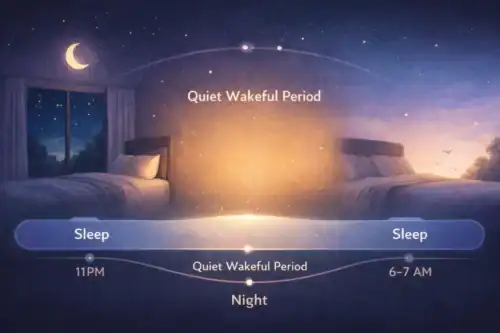
Biphasal sleep simply means sleeping in two segments rather than one long, uninterrupted stretch. Historically, this was common. Humans would sleep for several hours, wake briefly during the night, then sleep again until morning.
Some people still do this naturally and I’m one of them.
When I stopped trying to force myself into a single, continuous block of sleep, something unexpected happened: my anxiety dropped, my body relaxed, and, paradoxically, my sleep improved.
Not because I slept through the night, but because I stopped fighting the night.
What is Biphasal Sleep?
Humans haven’t always slept in one long, uninterrupted stretch.
Historical records from medieval Europe to pre-industrial societies describe a pattern often called segmented or biphasal sleep. People would sleep for several hours after dark, wake for a quiet period in the middle of the night, then return to sleep until morning.
During that nighttime waking period, people might:
- Pray or meditate
- Reflect or journal
- Tend a fire
- Talk quietly
- Simply rest in bed
Crucially, they did not interpret this waking as a problem.
From a biological perspective, sleep is governed by two overlapping systems:
- Circadian rhythm (your internal clock)
- Sleep pressure (how long you’ve been awake)
For some people, these systems naturally produce a brief window of alertness in the middle of the night—especially once sleep pressure has partially dissipated.
Modern expectations, including artificial lighting, work schedules, and the cultural ideal of “8 hours straight,” have reframed this normal variation as insomnia.
The Real Problem Was the Story I Believed About Sleep
Looking back, the hardest part wasn’t being awake at night: it was what I thought being awake meant:
- That my body was failing
- That tomorrow would be ruined
- That I needed to fix my sleep
- That every wake-up was a problem to solve
That internal alarm—something is wrong—was far more disruptive than the waking itself.
Once I reframed nighttime wakefulness as neutral, even normal for me, my nervous system stopped panicking. When the nervous system calms, sleep often follows.
What I Do Now When I Wake Up at Night
I no longer treat nighttime waking as an emergency. Instead, I treat it as a restful interlude. What follows are the keys I’ve learned.
Stay in Bed (Most of the Time)
I don’t jump up just because I’m awake. The old rule about “get out of bed after 15 minutes” turned out to be counterproductive for me.
Use Gentle Mindfulness Practices
These help my body feel safe, even if sleep doesn’t return right away:
- Slow breathing (like 4-6-8 or box breathing)
- Yoga Nidra or NSDR
- Counting backward or repeating a neutral phrase
The goal isn’t to force sleep; it’s to stay out of fight-or-flight. That also means avoiding any kind of stimulation, such as screens.
I Redefined Success
If I’m resting deeply, even awake, that still counts. Some nights I fall back asleep quickly. Some nights I don’t.
Both are okay.
What the Data Taught Me (and What It Didn’t)
Sleep trackers have been a double-edged sword for me.
They helped me see patterns, like how mindfulness or deep rest showed up as “rest” in some systems even when I was technically awake. But they also reinforced the idea that only sleep counts.
Here’s what I’ve learned:
- Not all rest looks like sleep
- A calm, awake body can still recover
- Numbers don’t always tell the whole story
My best nights now aren’t necessarily those with the highest sleep score. They’re the ones where I feel rested, grounded, and okay in my body the next day.
If You Wake Up at Night, You’re Not Broken
Especially if you’re a woman, especially if you’re sensitive, anxious, creative, or highly attuned—your nervous system may simply be wired for something other than eight uninterrupted hours.
If you wake up at night, you don’t necessarily need to fix anything. You might just need to stop arguing with your biology.
The Biggest Takeaway
Sleep isn’t something I try to fix anymore. It’s something I cooperate with.
When I stopped trying to force my body into a pattern it doesn’t naturally take, my nights softened. My days improved. And the long battle I’d been fighting finally ended.
Not because I fixed my sleep.
But because I finally understood it.
References
Humans Used to Sleep Twice Every Night. Here’s Why It Vanished.
Is Sleeping Through the Night the Right Way to Sleep?
Share this post!




This is very helpful because I have always thought something was wrong with me because I sleep in phases but still feel rested in the morning. After using the bathroom at 2 or 3 in the morning I will put on a podcasts, one with a soothing voice, even if I’ve listened to it before and find that it will lull me back to sleep. I awake rested several hours later. Thanks for putting a name to this other than making me feel something is wrong with me.
It has been an awakening (pun intended) for me! Glad you enjoyed the post.